Advice
Power Flush Cost and When You Need One
TL;DR
A power flush costs €350 to €550 for a standard home in Ireland. It clears sludge and rust debris from radiators and pipework. It is worth doing before installing a new boiler, if radiators have cold spots, or if the system is more than 10 years old without having been flushed.
What Is a Power Flush?
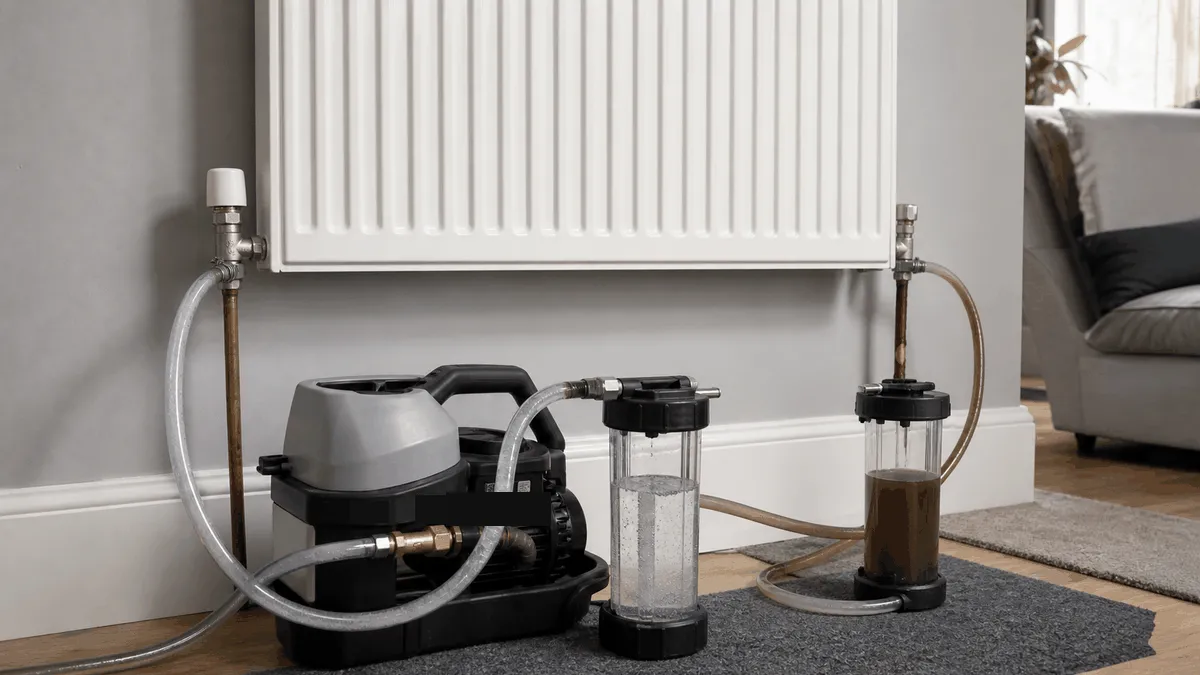
A power flush is a process that cleans a central heating system by pumping high-velocity water and cleaning chemicals through the pipes, radiators, and boiler heat exchanger. It dislodges and removes the sludge and rust debris that builds up inside a system over time. This debris (magnetite) reduces heating efficiency, causes cold spots in radiators, and eventually damages the boiler heat exchanger.
How Much Does a Power Flush Cost in Ireland?
Power flush pricing in Ireland depends on the number of radiators and the condition of the system:
- Up to 8 radiators: €350 to €450
- 8 to 12 radiators: €450 to €550
- 12 to 16 radiators: €550 to €650
- Severely sludged systems may cost more
- A magnetic filter should be fitted after a power flush (€80 to €120 typically)
Signs Your Heating System Needs a Power Flush
- Cold spots at the bottom of radiators
- Brown or black water when you bleed a radiator
- Some radiators slower to heat up than others
- Boiler making a rumbling or kettling noise
- Heating system slow to warm the house
- High fuel bills despite a relatively new boiler
- Radiators need frequent bleeding
Do You Always Need a Power Flush Before a New Boiler?
Modern condensing boilers are more sensitive to debris in the system than older non-condensing boilers. Most manufacturers require evidence that the system has been flushed to maintain the 10-year warranty. A power flush before a new boiler installation is strongly recommended by Murphy's Plumbing and is standard practice for any system that has not been treated in the past 5 years.
Power Flush vs Chemical Flush
A chemical flush uses cleaning chemicals circulated by the boiler's own pump rather than a high-velocity machine. It is less effective for heavily sludged systems but is suitable as a maintenance measure on cleaner systems. A power flush is recommended when there are active symptoms of sludge. A chemical flush is sometimes used annually after a power flush to keep the system clean.
What Happens During a Power Flush?
- A high-velocity pump is connected to the heating system
- Cleaning chemicals are added and circulated throughout the system
- Each radiator is isolated and flushed individually
- Flush water is discharged and checked for sludge and debris
- A neutraliser chemical is added and the system is refilled
- An inhibitor is added to protect against future corrosion
- A magnetic filter is fitted (recommended) to catch any remaining particles
Would you rather Conor handled it?
Central Heating, quoted before work starts.
Advice
Frequently asked questions
How long does a power flush take?
A power flush takes between 4 and 8 hours depending on the number of radiators and the level of sludge in the system. The process cannot be rushed as each radiator needs to be individually isolated and flushed.
Can I power flush my own heating system?
Power flush machines can be hired but the process requires knowledge of the system and experience in interpreting the results. Using the wrong chemical concentration or missing a zone can leave the system still partially blocked. Murphy's Plumbing carries out power flushes as a standard service.
Will a power flush damage my old pipes?
In a system with very corroded pipes, there is a small risk that a power flush could reveal existing weaknesses in joints or pipes that were previously held together by sludge. A reputable engineer will inspect the system before starting and flag any visible vulnerabilities.
How often should I power flush my heating system?
A system protected by a magnetic filter and annual chemical inhibitor treatment rarely needs more than one power flush in its lifetime. Without a filter, a power flush every 5 to 8 years is reasonable. Fitting a magnetic filter after the flush is the most cost-effective way to protect the system long-term.
Does a power flush sort out a noisy boiler?
If the boiler noise is a rumbling or kettling sound, sludge in the heat exchanger is often the cause. A power flush frequently resolves this. If the noise is a different type, clicking, banging, or high-pitched whistling, the cause may be something else that the power flush will not address.